清明上河圖
Along the River During the Qingming FestivalA twelfth-century handscroll, five and a quarter metres of a city waking up. Somewhere in the crowd stands a man who does not belong to it. Find him.
尋 Begin the hunt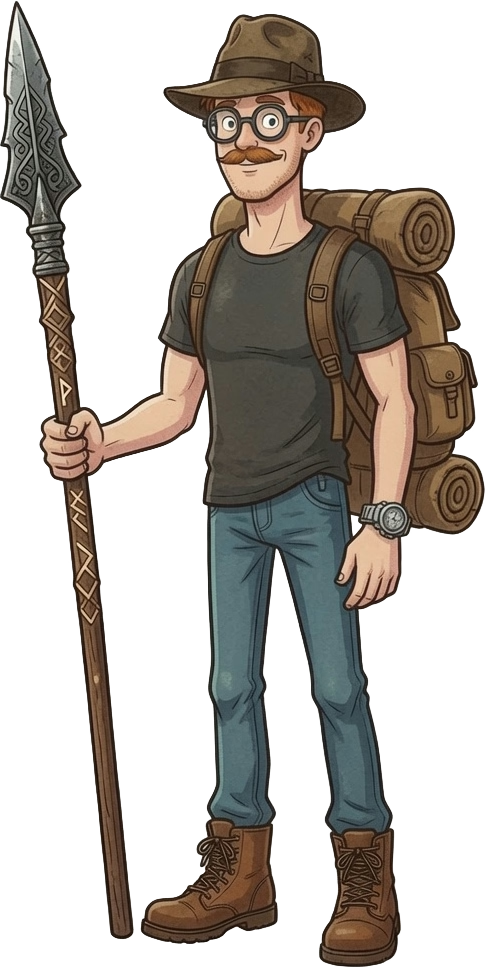

What you are looking for
A tall man in a brimmed hat and round glasses, a bedroll on his back and a spear in his right hand. He stands upright while the people around him stoop over their work.
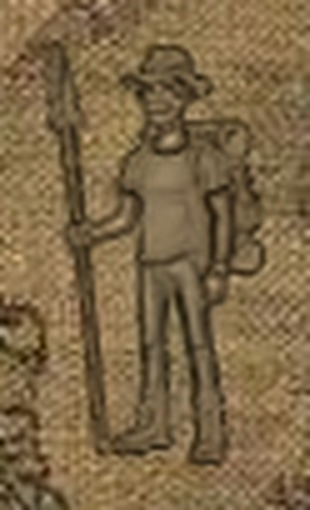
In the painting he does not look like that. He has been redrawn in the scroll's own hand — ochre ink on aged silk, the weave showing through him, his contours pitched to exactly the darkness of the porters beside him. He is not a bright cartoon pasted onto a brown picture.
What gives him away is posture and height: he stands a head above the Song adults around him, upright among stooped figures. That is the whole of your advantage.
畫The painting
Along the River During the Qingming Festival is attributed to Zhang Zeduan (張擇端), painted in the Northern Song around the turn of the twelfth century. It is ink and light colour on silk, 24.8 cm tall and 528 cm long, and it lives in the Palace Museum in Beijing.
It is not a landscape with people in it. It is a survey of labour: boatmen hauling against the current, a bridge crowded to the point of argument, porters, vendors, a camel train leaving by the gate. Something like eight hundred figures, none of them heroic, all of them busy. The painting's subject is a working city, and its method is to refuse a focal point.
卷Why a handscroll
A handscroll was never meant to be seen at once. You held it closed in your left hand, unrolled an arm's length with your right, looked, then wound the seen part away to reveal the next. The format has a reading direction and a pace, and it withholds — you cannot check the end without travelling there.
Which is to say a handscroll is already a search: a long space you move through a window at a time, unable to hold all of it in view. Putting a hidden figure in one does not impose a game on the painting so much as make explicit something the format was always doing. The viewer here keeps that constraint — you pan, you zoom, you lose your place.
數The figures
- Painted
- c. 1100Northern Song
- Silk
- 528 cm× 24.8 cm
- Scan
- 38 414 px× 1 800 px
- Tiles
- 192048 px wide
- Delivered
- 16 MBAVIF
- Waldos
- 1hidden once